
Danbury's Directory Shelf and Scans
Danbury has a local directory trail that begins with a verified 1877–78 file and continues through named late-nineteenth-century publishers, 1891 split scans, a broad twentieth-century file, and a 1992 Danbury–Bethel volume. The strongest first stop is the Danbury Museum digital archive. WCSU and established genealogy metadata help identify the publisher and year when a scan's landing page is brief.
| Collection | Years | Where Held | Access |
|---|---|---|---|
| Danbury City Directory | 1877–1878 | Danbury Museum digital archives | Downloadable scan |
| Webb's Danbury Directory | 1885–1886 | Museum and WCSU CT Room | Scan or onsite holdings |
| Carter and Co. | 1886–1887 | Genealogy metadata and WCSU | Publisher/year search |
| Thompson, Breed, and Crofutt | 1887–1888 | Established genealogy collection | Volume-level search |
| Fred B. Crofutt | 1888–1889, 1889, 1890 | Museum and genealogy metadata | Consecutive editions |
| Danbury files and Catalist | 1891, 20th century, 1992 | Museum digital archive | Split scans or staff help |
The table is a map, not a claim that every year survives. The Museum's twentieth-century landing page does not list each individual volume, and the last printed Danbury year was not located. Search an exact publisher and edition rather than treating “city directory” as one continuous run.
For the collection shelf itself, the Danbury Museum directory archive provides the local files.
The Museum's scan links make early Danbury city directories available without first traveling to a reading room. A downloaded page still needs the same care as a bound volume: retain the printed year, page, section, and exact spelling.
Webb to Crofutt in Danbury
The 1885–90 run is valuable because the publisher changes are visible. Wanton S. Webb's 1885–86 directory is followed by Carter and Co. for 1886–87, A.R. Thompson, H.B. Breed, and F.B. Crofutt for 1887–88, then Fred B. Crofutt editions for 1888–89, 1889, and 1890. A surname may be printed differently from one edition to the next, and a person can move between the citizen and business sections.
Established genealogy collection metadata describes the 1890 volume as covering a city of about 15,000 and roughly 41,400 people, chiefly heads of households. That is collection description, not a Danbury population count. It explains why a directory search can return many entries while still leaving out children, boarders, and unlisted people.
Use the publisher and edition as a search key at the named Danbury directory collection, then inspect the Museum or WCSU archive copy when the result needs a street section or abbreviation key.
WCSU's Danbury town records span 1826–1932, city records span 1889–1933, and ledgers span 1892–1969. Those collections do not replace a city directory, but they can confirm a council, tax, or municipal name after a directory produces a lead.
The Split 1891 Danbury Files
The Museum's 1891 directory is divided into A–L and M–Z files, with front matter and advertisements. Search both halves when a surname is uncertain, and read the front pages before interpreting the entries. Advertisements can supply a business name or neighborhood clue that the alphabetical list does not.
The split file also makes a good check on the Crofutt sequence. A name that appears in 1890 should be tested in both 1891 halves, then compared with the street section and a newspaper notice. Keep the page image or citation because a later transcription may flatten a symbol, abbreviation, or line break.
The Museum digital-archives page is the access point for the two 1891 files and their front matter. A directory page is evidence of what was printed in that edition. It does not convert an annual entry into a continuous residence record.
Later Danbury Directory Files
The broad “20th Century Danbury Directories” file is useful for later research, but its landing page does not list every volume year. Museum staff can identify the exact file or run when a name or address is known. The 1992 Catalist Danbury–Bethel Directory is a more specific later anchor. Distinguish Danbury entries from Bethel entries before drawing an address conclusion.
The Library and Museum also hold school yearbooks, family surname files, tax lists, cemetery records, military material, and newspaper microfilm. These are companion collections, not interchangeable city directories. A school yearbook can reconnect classmates; a newspaper can date a marriage or move; a tax list can support an ownership clue.
The Danbury Library local-history page explains the handoff of historic local materials to the Museum.
When a city directory stops, the local-history trail often continues through the Library, Museum, WCSU, State Library, and newspaper collections.
How to Read a Danbury Directory Entry
A Danbury city directory entry should be read as a bundle of clues. An authoritative Yale exhibit that references Carter's 1886–87 and a Crofutt directory shows the useful shape: a general citizen section arranged by surname, an address, an occupation or business clue, a business directory, and a street or appendix section. The exact fields vary by edition, so the Museum scan controls the final reading.
| Printed name | Often a head of household or principal name; retain initials, punctuation, and spelling. |
|---|---|
| Occupation | A work or business clue that can separate two people with the same name. |
| Address | House number and street, sometimes with a residence, boarding, spouse, or widow mark. |
| Business section | Commercial entries that can connect a person to a shop, office, or trade. |
| Street section | Address-order reading that can show another occupant, business, or nearby household. |
- Criss-cross section
- An address-order or street-order section used to work from a number back to a printed name.
- Householder index
- A name-focused list that generally emphasizes the principal or head recorded for a household.
- Abbreviation key
- The volume's explanation of marks such as boarding, widow, business, or address notation.
- Index versus image
- A searchable label can point to a page; the scan shows the type, spacing, and symbols that the label may omit.
Read the key first. Do not expand a spouse, widow, or boarding mark from memory. Then use the street section to test whether the address holds one household, several names, or a business.
Turn Danbury Streets Into Leads
Address-first work begins with the printed number and street. Search the current spelling, likely older spelling, street-only, and number-only forms. A historic street name or suffix may not match the modern assessor dropdown. Use MBL, legal description, map, and neighboring parcels to bridge the difference instead of assuming a missing name.
Once an entry is found, write down the exact name, occupation, spouse or widow notation, business, and page. Search the same name in the alphabetical section, then test a deed, property card, newspaper, probate record, cemetery file, or census year. A directory entry becomes much stronger when two independent sources share an address, occupation, relative, or date.
Current parcel work belongs in the Danbury street directory, where the assessor, AxisGIS, and land-record chain are kept in their modern address context.
Where Danbury Directories Are Held
The Danbury Museum, 43 Main Street, lists staff-assisted onsite research by appointment, one researcher per slot, Wednesday through Saturday afternoons, and a research specialist Wednesday through Saturday. Its holdings include early city directories, newspapers, family surname files, census and vital material, Grand Tax Lists, cemeteries, deeds, school yearbooks, military records, and municipal papers. The Museum lists $0.25 copies and microfilm prints, and remote research at $25 per half-hour with the first half-hour prepaid.
The Library at 170 Main Street, phone 203-797-4505, directs historic local-history material to the Museum and provides newspaper and reference routes. The State Library research gateway links census, maps, probate, newspapers, genealogy, and old-house material. WCSU Archives supplies finding aids for Danbury town, city, and ledger records. State Archives access in Hartford should be confirmed before travel because some collections may be offsite during shelving work.
The Museum's research holdings and appointment page supplies the local rules.
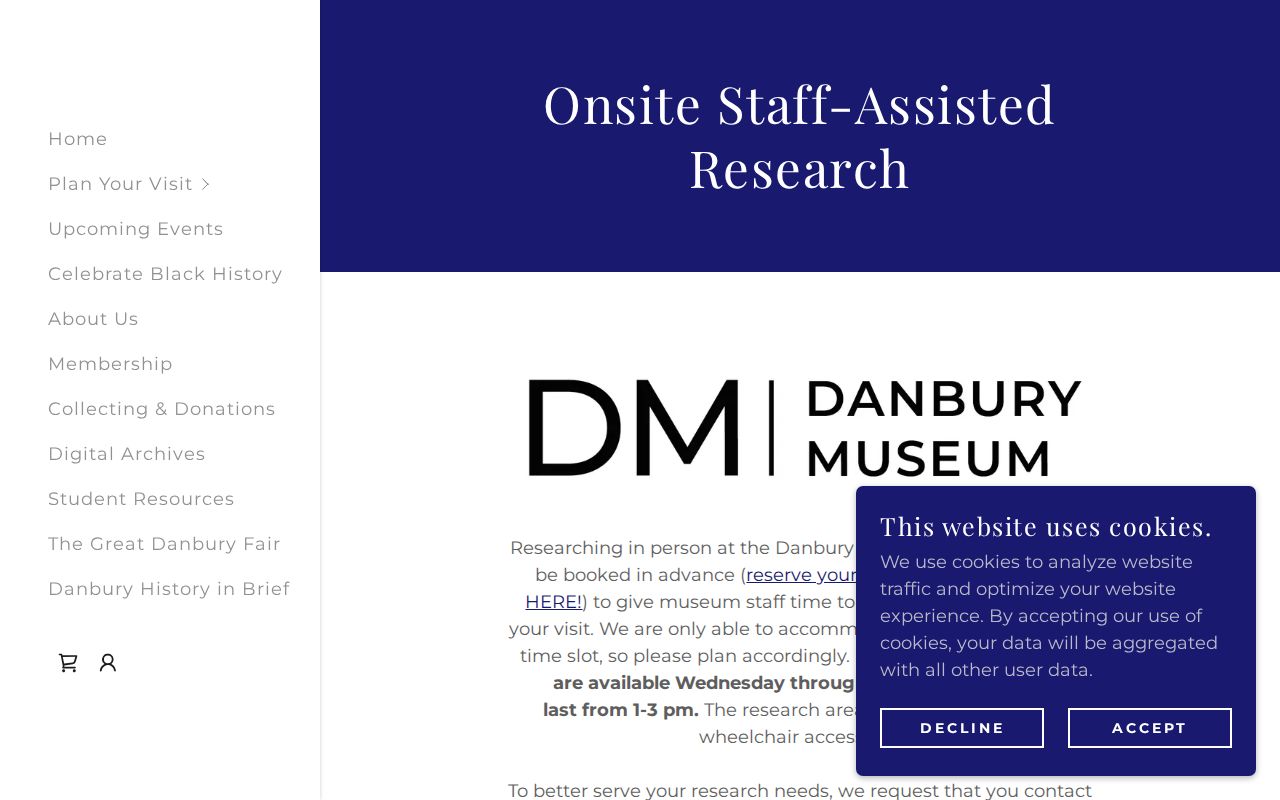
Use #2 pencils at the Museum, keep food and drink away from the collections, and ask staff about a volume that is not listed by exact year. Those practical rules are part of the access path.
Trace Danbury Families Through Years
A directory trace works best when years are treated as snapshots between census dates. The 1890 federal census loss makes the Crofutt 1890 volume and 1891 files especially useful, but they still need corroboration. A move, death, business change, or missing entry can all interrupt the run.
- Choose a publisher and year, then record the exact printed name, page, address, occupation, and symbol key.
- Search the same person in the next directory, testing maiden names, initials, suffixes, and occupation changes.
- Read the street section to see whether the address has another name, business, or boarding notation.
- Pair the directory date with nearby census years: 1880, the fragmentary 1890 substitute, 1900, 1910, 1920, 1930, 1940, and 1950.
- Close a change with a deed, newspaper, probate, vital, cemetery, or Museum family file.
Disappearance is not a single answer. The person may have moved, died, changed a name, become unlisted, or fallen outside the volume's coverage. A directory, obituary, deed, and census can tell different parts of the same story. Keep the source relationship clear.
Danbury Directory Timeline
The local sequence is short enough to see at a glance and rich enough to guide a search. Publisher changes matter because the same address can be indexed under different spellings or sections.
| Period | Local marker | Use in research |
|---|---|---|
| 1877–1878 | Earliest verified Museum directory file | Name, business, and street reading |
| 1885–1890 | Webb, Carter, Thompson/Breed/Crofutt, and Crofutt runs | Year-to-year household and occupation checks |
| 1891 | A–L and M–Z Museum scans with front matter | Follow-up to the lost 1890 census context |
| 20th century | Broad Museum file; exact years not listed | Ask staff to identify the needed volume |
| 1992 | Catalist Danbury–Bethel Directory | Later name and business snapshot |
Note: The exact last printed Danbury directory year was not located, so the 1992 Catalist file is not presented as the final volume.
Danbury Newspapers Close the Gap
Newspapers can explain a directory change that the volume alone cannot. Library and Museum routes include historical Danbury News and News-Times material, while the State Library advertises a newspaper index extending from 1758 to the present. The Library notes that historic News-Times and Evening News material moved to the Museum. The Library of Congress identifies Danbury News from 1870–1933 and News-Times from 1963 forward.
Use an obituary, marriage notice, business announcement, or civic item as a dated corroboration. Index coverage varies by title and issue, so treat a hit as a lead until the newspaper page or microfilm is checked. The Danbury Library newspaper page explains recent, State Library, and digital newspaper access.
A city directory, newspaper, and census pairing can identify a former Danbury household without confusing a printed annual entry with a certified vital record.